The Death of a Jew


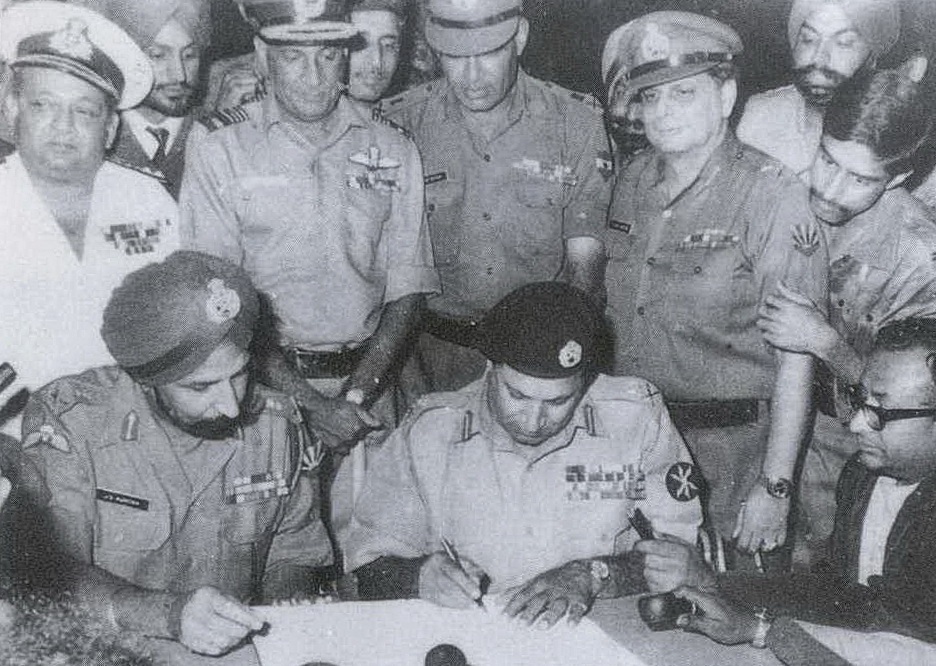
Following close upon the golden jubilee celebrations of ‘victory’ in the 1965 war against Pakistan, with its imbedded celebration of the Anglo-Indian hero Alfred Cooke, has come another moment of remembrance in the history of the Indian state: the passing of J.F.R. Jacob. Jacob was, more or less famously, the only ‘Jewish general’ in the Indian Army and one of the architects of the Pakistani surrender in the Bangladesh War. His visage graces the iconic photograph of the surrender ceremony in Dhaka in 1971. (Jacob stands towards the right of the frame, above, with a young Air Force officer gripping his arm.) By his own admission, Jacob was not a religious man and may not have been entirely comfortable with the tendency of his admirers – mainly Indian and Israeli – to underline his Jewishness. Nevertheless, every obituary has led with some version of ‘Jake the Jew.’
How extraordinary this treatment is must be emphasized. When Sam Maneckshaw, the most celebrated soldier in Indian history, died not long ago, few headline-writers in the mainstream press thought to describe him as ‘the Parsi general,’ and no eulogist gloated about the fact that a Zoroastrian had led the Indian Army. Likewise, when Air Chief Marshall Idris Latif, the only Muslim to head an Indian military service, passes away, his religion will be mentioned politely in the small print, as is only right. Denis La Fontaine will not be 'India's Christian air chief'; Christians are too prosaic. Clearly, being a ‘minority,’ in and of itself, is not all that noteworthy. When it is noteworthy, it is unevenly so:  Alfred Cooke was embraced in spite of his Anglo-Indian ancestry (and even then, nobody mentioned his religion), but Jacob was celebrated because he was an Indian Jew. Coming at a time when minorities are not especially popular in India, this invites us to think about the conditions under which a national majority becomes generous towards the impurities it contains.
The concept of a ‘minority’ is something of a novelty. It became meaningful only in the nineteenth century, as a corollary of the new institutions of popular sovereignty and the democratic nation-state. In India, the term was most firmly associated with Muslims, beginning with colonial historiography, proceeding through Aligarh’s foundational debates and the nationalist polemics of the 1880s and 1890s, and becoming concretized in the Minto-Morley reforms of 1909. Partition reinforced the concrete, but also added a new complication by making policy (management) rather than politics (accommodation) the normative idiom of relations between the majority and the minorities. Throughout this trajectory, the concept secreted layers of negative connotations: not only was it a calamity to be a minority, it was a misfortune to have minorities. In much of this, the Indian experience was consistent with trends in political demography elsewhere in the world that emerged from the Great War.
Yet models exist in that world for ‘good minorities’ and even happy minorities. The best known such model is, conveniently, known in America as the ‘model minority.’ That term has been used since the 1970s to refer explicitly to ‘Asian immigrants,’ who do well at school, do not trouble the police, and appear to affirm the ‘American’ values of hard work, self-reliance (not relying upon government assistance), single-minded acquisitiveness and ‘family,’ at a time (the aftermath of the Counterculture and the Civil Rights Movement) when ‘Americans’ themselves had evidently wavered in their faith in those things. The deconstruction of the model minority, coming in the first instance from Asian American scholars like Ronald Takaki, has been very thorough. Its critics have noted that while the notion compensated somewhat for the virulence of the Asian Exclusion Acts, the lynch mobs in the Pacific Northwest, the wartime internment of people of Japanese ancestry, and seventy years of murder and dehumanization of ‘gooks’ and ‘slopes’ (who can breathe easier now that attention has turned to ‘ragheads’ and ‘Art Malik’), it has been more pernicious than generous. It has highlighted the success of some Asians (mainly Japanese, Chinese, Koreans and Indians from middle-class backgrounds), blacked out the less advantaged and successful, and trapped all Asian Americans within the exotic category of ‘immigrant,’ to be contrasted with real Americans, whose realness is reified by their imperiled virtues. The model minority is a handy stick with which to beat other minorities (including Asians, but always and primarily blacks, Hispanics and Native Americans) for their apparent fecklessness. Beyond that, it has imposed on all minorities – the successful and the feckless – a constricting model of citizenship that emphasizes docility: not challenging the prerogatives of the majority, not questioning the meanings of success, not taking over the ‘good schools’ and ‘excellent neighborhoods,’ not making waves. The model minority is, in the final analysis, a model of apolitical citizenship as the subjectivity of a ‘good’ minority, which allows the majority to bury its history and politics of racism.
The notion of a ‘good minority’ is not alien to India, where linguistic minorities have been a fact of political life since the 1920s. In the Presidency capitals, an expanded political pie and massive in-migration made it necessary for regional politicians to work out a language that could accommodate – or isolate – the misfits. But who was a good minority at the national level? For a long time, the answer was obvious: the model minority in India were the Sikhs. Not only did they fit easily into the anti-Muslim thrust of nationalist historiography, they were endowed with qualities that Hindus were often unsure they possessed: Sikhs were industrious, ‘martial’ and hyper-patriotic. It was a nationalist redemption of the colonial trope of the simple, loyal peasant-soldier. Sikhs themselves seemed to embrace their role as semi-detached Hindus, and happily referred to themselves as the ‘sword arm of the nation.’
The fragility of this model of minority citizenship became inescapable in the 1980s, with the onset of Sikh terrorism, the Delhi pogrom, and the years of profiling and ‘encounter’ killings. When Shabeg Singh, another icon of the 1971 war, used his military expertise against the Indian Army in Operation Blue Star, the hero became the traitor in shockingly literal terms. The wounds healed with Manmohan Singh’s stint as prime minister, but not completely. The romance was gone, and the good minority is nothing if not a romantic concept: a specter of the majority’s love affair with its own national mythology.
What went wrong with the Sikhs? It was not simply the demands for autonomy or secession. It was the revelation of a reluctance to accept the status of quasi-Hindus, which fully-credentialed Hindus could neither understand nor forgive. (Nothing is as embarrassing as interrupted self-love.) Just as pertinently, Sikhs asserting their separateness – whether from Hindus or from India – were able to mobilize politically. Even a two-percent minority can do that when two percent is more than fifteen million people, concentrated geographically and already equipped with political organizations and useful histories. The otherwise useful Sikhs, therefore, failed that crucial test of a lovable minority: docility.
If we return to the photograph of the Pakistani surrender in 1971, in which the romance of Indian cosmopolitanism is fully on display, we see immediately that Sikhs are well represented, notably by General Arora, the senior Indian commander in the eastern theater. They are not, however, performing as a minority. Being politically alive and viable, Sikhs are not exotic. They are not in the frame as curiosities. General Jacob is. Some three decades ago, a relative of mine – a retired group captain in the Indian Air Force – told me that Jacob’s presence at the ceremony was intended to compound the Pakistani humiliation by forcing them to surrender to a Jew. It is difficult to imagine Indira Gandhi and Jagjivan Ram plotting such a detail, but it is significant that it was the perception of Indian officers with some awareness of world politics. Jacob in 1971 was already a symbolic Jew.
He was also the most perfect kind of minority: a man with a race but without a racial community. The number of Jews in India is so small (barely five thousand) that mobilizing as a community – coming together with an agenda and a means of applying pressure – would seem to be out of the question. Indian Jews can, at most, express their dismay when some fool in Ahmedabad opens a boutique called ‘Hitler.’ They are, in that sense, a docile minority, and can be placed on the shelf of the nation's trophies. The same can be said for Parsis. They too are a model minority, running gracefully out of bodies and vultures. The Tatas have put to rest the old Parsi reputation of being ‘bum-lickers of the English’: a stigma that Anglo-Indians could not fully escape. In Bapsi Sidhwa’s novel Cracking India, a Parsi woman in newly independent Pakistan explains to her child that they are, and must remain, like sugar in a cup of tea: sweetening and invisible. But the Parsi predicament is also different from that of Indian Jews. Jews are more useful. Being Parsi has no global significance. Jewishess does, and that meaning dovetails with specific Indian agendas, historical and contemporary.
The post-1945 Zionist tendency to deploy an exceptional and existential victimhood – ‘everybody hates us, so everything is justified’ – has made it possible for Indian nationalist discourse to claim an exception of its own. In India, the narrative goes, Jews were never persecuted. This may very well be true, give or take the Inquisition in Goa. But the assertion has not only allowed the spokesmen of the Indian majority to proclaim their own ‘tolerance’ and inherent cosmopolitanism (which, it turns out, is compatible with fascist imaginings of nationhood), it has also aligned them with a strand within contemporary Zionism, which is its anti-Muslim animus. This promises to take Hindutva politics out of the backwater, connecting it to another national narrative and a global concern (articulated in terms of ‘terror,’ ‘security' and 'Islam'). It also cements the relationship between India and Israel at a time when both states have reached a majoritarian nadir.
It may be, of course, that eulogists casually invoking 'Jake the Jew' are merely drawing attention to a harmless bit of trivia, without political 'intentions' or 'agendas.' When they do that, however, they reduce race and the racialized individual to trivia: the harmless fluff that is the essence of a model minority. The harmlessless is tied up with utility and the comfort of the majority; for that reason, it is political. The celebration of General Jacob’s Jewishness then feeds (and feeds upon) majoritarian self-congratulation and tokenism, and simultaneously sharpens the distinction between good and bad minorities in India. The more or less solitary Jew, identified with national victory and globally aligned with power and civilization, is good. The Muslim, with his numbers and birthrate and place in history, is not. He is the trouble the Jew does not give the nation. He is unser Unglück. Sikhs have proved to be manageable; they can be either pogrom victims or prime ministers.
Jacob was not an innocent observer in the politics of his identity. He may have been ambivalent about his faith, but he took racial identity seriously enough to work hard for closer ties between the Indian and Israeli states. That effort, while understandable, highlights an important dynamic of being a model minority. It shows where, and with whom, one chooses to stand, and how one is willing to be used. When a minority lacks the demographic means of political self-assertion, there still remains the option of self-assertion on behalf of other minorities, within the larger community with which it identifies. Jacob liked to say he was ‘Indian through and through.’ I would like to think that that means standing in solidarity with those Indians who are excluded from ‘model’ status. Such solidarity, however, might mean that when you die, you would not be a national icon, but merely a troublemaker.

January 18, 2016

Life in the Jungle


An old friend died recently on the other side of the planet. It was both predictable and shocking, as these things often are. He was a long-term abuser of powders and pills; I had not expected him to live as long as he did. Still, we had been children together, neighbors, brothers almost, at that crucial period in modern male friendship: early adolescence. So I was shaken when I got the call from another friend and ex-neighbor. It was as if a few bricks fell away from the walls of my house, but it wasn't a house I live in anymore.

Over the next few days, the grapevines of social media (through which old acquaintances had tried to reimagine themselves as old friends) yielded slippery details and problems. He had died in his sleep in a hotel in Paharganj, the seedy Delhi neighborhood frequented by white tourists in dirty pyjamas. A bottle of sleeping pills was found in his bag. His mother was with him. They had been traveling together from Moscow to Durgapur, the industrial city where we had lived as children; she had spent the night in the same bed unaware that he was dead. She had dementia and a tendency to wander off. There was a brother in Canada; he was on his way but, we were informed, reluctant to take his mother back with him. The mutual friend and I tried to find an old-age home in our old hometown where she could be safely abandoned, among people who might visit her once or twice.

I also tried to remember the dead man, or boy. I dreamed of him several nights in a row even though we had not spoken in nearly thirty years. This lag was not due to a quarrel, but because we had drifted so far apart that nothing was mutually comprehensible or relevant. So it was startling to find photographs of a big-eared twelve-year-old slouching in his room circa 1982. It regenerated a face, which allowed other images and sounds to creep back: the grinning face in my window on weekend mornings, the stuttering shout of my name, his presence in my house on the day of the year when sisters give their brothers a protective fingerprint (having no sister of his own, he would borrow mine), the telephone ringing just when my mother was taking her cherished siesta on her day off from teaching. I remembered endless hours of batting practice, and the sight of him airborne before his delivery stride, head cocked, arm and wrist coiled, lanky. He revered Michael Holding. I remembered a small crime we had conspired to commit (inspired by James Hadley Chase) and the unraveling of the conspiracy, the embarrassed-indulgent rage of parents. I was able to recall an even older image, from before we became friends: a boy of five or six throwing a tearful tantrum on the bus because he didn't want to go to school. It’s not that I had never thought of these things in three decades. But it had been knowledge rather than remembrance, cut off from life.

It was, among other things, knowledge of waste and luck, which is why it had been pushed to the margins of memory. One more boy wasted by a system of education, examinations and professional bottlenecks that gave no quarter to those who could not, or did not want to, stay in the fast lane, which was also the only lane. Healthy competition, the schools called it, as if there was something laudable about brutal hours of cramming and 'private tuition,' fetishizing ‘coming first’ in examinations, being ‘ranked’ in your class beginning when you were five years old, the smugness and alarm of parents who shared the hierarchy of their children, and the fear of falling out of the middle class altogether. The perversity of that education was inseparable from our teachers' proclivity for creative physical violence. I don't look back at my Indian schooling with any pleasure or nostalgia; the memory of those grey walls is enough to fill my stomach with a dull anxiety. I lived with the nausea – the longing to be anywhere else instead – for nearly ten years. (The feeling came back to me when I began dropping my daughter off at school, and I had to force myself to see that her school was not what mine had been.) My dead friend, who had been an intelligent boy with eclectic interests and bookshelves, was also an average student in a system that chewed up such children. I got out just in time; he did not and became a ‘failure.’ When I met him again at the age of nineteen, he was injecting heroin into his scrotum and stealing cough syrup. He had nothing to say that was not recycled tripe. He was not the only one. There but for the grace of God went I.

The Jesuit jailhouse of our childhood dissolved into the city itself, turning it grey: grey school-buses, grey shorts, grey mornings, dirty white sky. As with the school, I can’t go back there without a sense of dread. I know this contradicts the conventions of NRI nostalgia. (But then, bin Ich nicht ein bloede NRI.) We are supposed to look back with affection and pride, and there is undeniably something romantic about Durgapur and other ‘steel towns’ that came up in India in the 1950s. This was the frontier of Nehru and Bidhan Roy: instant cities in the wilderness that had secreted legendary bandits like Bhabani Pathak and Ichhai Ghosh, marked by receding forests, smoke-stacks, geometric housing developments, no extremes of wealth and poverty, no crime to speak of (polite scientists and their well-bred wives had replaced the bandits), no filth on the streets (but nasty chemicals in the air and the river), sheltered and sheltering, a modern Indian Eden where everybody knew their neighbors and spoke three languages, and nobody talked about religion or caste. In the evening, the horizon would turn an attractive orange as the blast furnaces roared and released their slag.

As a new city where even the old residents were first-generation migrants from elsewhere, Durgapur was a place constituted by arrivals and departures. Men and women came, recognizing their roles as pioneers, but expecting to leave at the end of their working lives. Parts of the town retained that touch of the makeshift: Steel Market, where we bought Tintins and textbooks, cricket balls and orange squash, was a double row of Quonset huts corrugated-iron barracks on a dirt road. For children, home was always encroached upon by departure, because the same schools that consumed their lives in the city would spit them out of the city, towards ‘real’ cities where there were colleges, careers and airports. (Durgapur had only a railway station.) To remain in this place was a sign of failure.

Into this place that was also no place at all, at some point in the mid-1960s, my friend’s mother had come, a Russian scientist who had married an Indian engineer given to spells of withdrawal and melancholy, and what was probably schizophrenia. The few friends she made in Durgapur included my mother. Birokto korbena (“Don’t bother me”), she told my mother, was her husband’s frequent response to her desire for his company. She had hung on for a long time. As a foreigner, she was even more afflicted by the limbo between arrival and eventual departure; the sense of isolation must have been acute. I remember her – and her husband – as being simultaneously present and absent, inseparable from the failure that swallowed my friend. In attractively modern company housing, husbands turned cold and wives seethed with rage at being stranded in the jungle with their various disappointments, while children lingered on the cricket field after dark or wandered the streets in the burning heat of May afternoons because it was better than going home. Anyone could turn feral. The town wasted the Russian woman just as it wasted her son, and there’s a morbid irony in the likelihood that she will live out her final years there, in this wilderness of unreliable memory. There but for the grace of God; but quite a few of us did go there.

I had left. I escaped miraculously, due to the mad initiative of parents who recognized the importance of getting out, even though their own education and aspiration had been focused on reaching places like Durgapur. Leaving destroyed them professionally, socially and personally, turning them into slightly shocking shadows of their confident and accomplished selves; immigration is not for the middle-aged. But it got the kids off the conveyor belt to nowhere. My friend who died understood that. He once sent me an email in which the only coherent thing was his resentment that I had flown the coop while I was still alive.

So perhaps it’s understandable that I associate the place with death: arrivals culminating in necessary departures. I first arrived in Durgapur when my parents stepped off the Coal Field Express on to the platform, my father carrying me in a bassinet. Quite by coincidence, I last saw my father at the same railway station, when he put me on a train bound for Indore. It may very well have been the same platform. The Coal Field passed through before my train pulled in and we said goodbye. Four months later he was dead, alone. I used to take the Coal Field sometimes when I accompanied my father on his trips to Calcutta. Fish and chips in the dining car, the thrill of the big city and what must be the real world. Lunch at Kwality or cake at Flury’s to bribe me into visiting relatives. Temporary getaways.

A lot of this is the neurosis of the emigrant, of course. For most of my friends from Durgapur, the place is mundane. Some have laid to rest the ghosts of engineers’ colonies and borrowed time, bought homes and started businesses, made it a hometown like any other. There is even an airport now, although not many flights. But on the two or three occasions that I’ve gone back, I’ve been haunted both by the fact that the place has changed, and by the suspicion that it hasn’t. Is it even sadder now, or was it always sad? Were the roads always narrow and the buildings a little drab? Had the open spaces that I remembered vanished, or never been there at all? And I went back to Ohio / But my city was gone. But the school is still there, with the grimy boys in grey shorts, living in homes that shade into the jungle, studying feverishly to get out. When I had tried to explain to my friend, during our failed attempt to reconnect by email, that I found Durgapur depressing, he had again become enraged: he claimed the place, and I was the condescending NRI. He was too wasted for me to convey that ‘going to Durgapur’ was like visiting my own grave, charged with the fear of discovering things best forgotten, like dead boys and the holes we come from.

December 4, 2015

Meat and Murder

My Photo

Some days ago, in a nondescript village named Dadri in the Indian state of Uttar Pradesh, a mob dragged a blacksmith named Mohammed Akhlaq out of his home and bludgeoned him to death. They also beat his son, leaving him with severe head injuries and possibly brain damage. The “provocation” was a rumor that a cow had been killed in the village for its meat, and the Akhlaqs – one of only two Muslim families in Dadri – has some meat in their freezer. The mob included multiple BJP men and their relatives. Some have been arrested, although trial and conviction are another matter; various high-ups in the party are already clamoring for their release. The meat in the freezer was sent off to a lab to determine if it was in fact beef; the lab has gone mysteriously silent about its findings. Because the incident was both shocking and commonplace (another lynching has already occurred), it is far from over.

The commonplace character of what happened in Dadri should be readily apparent to those familiar with the politics of lynching in modern India. It has all the usual ingredients: not just religious identity, but caste, class, gender, and the complicity of the state. It’s a Thakur village, the locals sullenly told journalists, as if that explained the murder, and indeed, it provides a part of the explanation. Lynching, along with rape, is an established mechanism of the maintenance of upper-caste dominance in the rural north. It was in a Thakur village, Behmai, that Phoolan Devi was famously gang-raped and paraded naked. In Dadri, as in Behmai, it was a male crowd; such violence is a normative performance of masculine dominance and a reminder that public space in northern India is pathologically homosocial. The perpetrators seem to have come from the demographic that straddles the village and the city in a country that is economically liberalized but ideologically illiberal: cell-phone-toting goons, not poor but viscerally hostile both to the cosmopolitan elite and to the marginal. Typically, the police come from the same classes and show the same inclinations. Days after the killing of Mohammed Akhlaq, a video emerged of a Dalit family in Dankaur (on the outskirts of Delhi), naked before a milling crowd of cops and onlookers. The family had wanted to report a theft; the police had refused to file a report. Dalit activists claimed the family was stripped and beaten by the police for complaining too much; the police insisted the family had stripped in a voluntary act of protest. The Dadri and Dankaur incidents are "old" phenomena, rooted in patterns of dominance and vulnerability, uppity-ness and punishment, that have marked the informal exercise of power in India for decades.These things happen, as Jyoti Basu once said.

Pointing out that “oldness” has, in fact, been the response of the government and its defenders, confronted with the backlash from liberal intellectuals. Most prominently, forty-odd writers, Sahitya Akademi prize-winners, have returned their awards in protest against the Akademi’s silence in the face of violence and repression, leading the BJP Minister of Culture Mahesh Sharma – whose views on culture are disturbingly reminiscent of Joseph Goebbels – to retort that the protesters expressed no comparable outrage when “these things” happened in the past. Sharma and his ilk have a point, in the sense that Indian liberals have generally treated egregious violations of the rights of minorities as an aberration, albeit a chronic problem, within a nationhood they embraced.

But what the defenders of the regime refuse to acknowledge is that the current situation is also substantially new. The lynching of Akhlaq is one piece of a larger crisis of Indian nationhood, marked by, among other things, the BJP’s energetic efforts to police meat-eating, the murder of the “rationalist” writer M.M. Kalburgi, the banning of Pakistani musicians from Mumbai, the exclusion of Muslims and Christians from Garba celebrations in Gujarat, and a pattern of silence and vitriol from the government in which the prime minister maintains an icy silence while his underlings and affiliates spew hate (and eventually claim they were misquoted). Indeed, it was Kalburgi’s murder, not Akhlaq’s, that precipitated the current protests; the death of a liberal Hindu and Sahitya Akademi member has miraculously enfolded the death of a Muslim villager. Similarly, the Shiv Sena’s assault on the journalist Sudheendra Kulkarni – a former BJP man who had refused to back down from promoting a book by a former Pakistani minister – has enfolded and highlighted the relentless drip-drip of hate-crimes against Muslims. Now that Hindutva has reached the stage of devouring its own, its other depredations touch the lives of those who never had occasion to doubt their place in the nation. That package of problems is more or less unprecedented in India, although not in Bangladesh or even Pakistan. And it is that proximity – the realization that India, with its smugness about democratic traditions and constitutional liberties, is now unmistakably like Bangladesh or Pakistan – that is at the heart of the outrage. The yeh daag daag ujaala moment, which came early to Pakistan, is finally, undeniably, India's moment also.

What appears to be a quixotic and hypocritical protest, targeting a literary association for the failings of the state, is thus increasingly coherent and meaningful. It is not really aimed at the Sahitya Akademi or even its feckless leadership. Everybody – including the government – understands that it is aimed at the state. This is why the police have already begun visiting the protesting writers, asking questions about conspiracies that might have a bearing on “security,” and harassing journalists who publicize the politics of beef. It is not limited to the state either. Rather, it recognizes that the state is functioning in a mutually sustaining but deniable and sometimes conflicted partnership with an assortment of reactionary forces, including a section of civil society. It is, in that sense, an unprecedented rebellion against a dispensation that is diffused through Indian society, and the discovery of a “voice” that had been all but lost after the BJP’s victory in the last general election.

The protests are unprecedented because the dispensation itself has no apparent precedent. Indian nationalism has had a powerful reformist element from the outset. From Ram Mohun Roy through Vidyasagar and Vivekananda to Rabindranath, Gandhi, Nehru and Ambedkar, to be Indian was to see moral reevaluation and social reform – sometimes articulated along the lines of the Enlightenment and sometimes in more innovative idioms, but always in terms of an incomplete structure of social justice – as desirable. This provided a way of answering the most basic questions of anti-colonial nationalism in a newly imagined  polity – “Who is Indian?” and “What is independence for?” – in ways that were not narrowly ethnic or self-defeating, and it underlay Indian secularism and cosmopolitanism. It was a minority position, and few “reformists” actually married widows, forgot their caste, or told their daughters that careers mattered more than marrying "a suitable boy." Nevertheless, the premise that nationhood must be transformational outlasted the colonial specter that had long made reformism suspect. It informed the ability of Calcutta-born Bengali-speakers to feel at home in Kerala, Rajasthan and Delhi, the writing of the Indian Constitution, the phenomenon of Nehruvian optimism, and respectable public discourse well beyond Nehru. It may have been inconsistent and internally conflicted, but it was real, the outcome of generations of political and intellectual labor.

The major premises of the new dispensation, on the other hand, deny that reform and social justice are existential concerns of nationhood. One is the Savarkarite formulation that Indianness is ethnic even when it is transregional: when Hindu identity is complete, so is Indianness. Another is the older idea that reformism is “western” and antithetical to a stable national essence. The third, which particularly suffuses the BJP’s urban, NRI and middle-class supporters, is that they are already reformed and introspection and change are both unnecessary and offensive. The rhetoric of people like Mahesh Sharma and Narendra Modi encapsulates all three premises. Taken together, they amount to a violently exclusionary and majoritarian posture of citizenship.

The triumph of that posture cannot be blamed entirely on the Modi government. It has been nearly thirty years since India did away with jus soli, which automatically conferred citizenship upon those born on Indian soil. The new doctrine of inherited citizenship and naturalization at the discretion of the state brought India in line with Margaret Thatcher’s Britain (which also discarded birthright citizenship) and other European countries with strong ethnic anxieties, seeking to keep the pitribhumi safe from Bangladeshi migrants, Pakistani infiltrators and overstaying hippies. (Pakistan, it is worth noting, still has jus soli, as a residue of its foundational ideology and English common law.) The Indian intelligentsia accepted it, barely noticing either the amendment of the law or its ideological implications. In doing so, it displayed the timid, shallow, backsliding liberalism of a class that not only lacked confidence, but felt guilty about its place in the national vanguard.  Because it remained unconvinced by what it might say in protest, the right to free expression remained compromised and muted for all but those who had recourse to the brute force of majorities and mobs. I am reminded of another writerly spat: Sunil Gangopadhyay refusing to defend Taslima Nasreen, saying “We are not ready for that kind of freedom of speech.” By that fearful logic, “we” are ready for neither independence nor universal suffrage. It is precisely this complicity in repression that set the stage for the predicament of the present time, when membership in the national community is literally a matter of flesh and blood.

In this citizenship of pure and impure DNA, what you eat is intertwined with where you belong, and anything can happen to the impure of mouth and mind. The Chief Minister of Haryana can resort to dietary intimidation, blacksmiths and intellectuals can be murdered, Northeastern women can be sexually victimized in the national capital because they are whores anyway, and Muslim journalists who criticize the dispensation can be abused in the filthiest terms on online forums. Naseeruddin Shah, the most acclaimed actor India has produced, can find himself under attack for the mildest praise of Pakistan, and must respond that he is a patriot who has never been aware of being Muslim. Shah's response is a nicety of secular-Indian speech, but it is nevertheless true that there were contexts in which Indians could forget their “communities.” Now those contexts have shrunk dramatically not just for “minorities” and the “sickular,” but also for insufficiently pure insiders, as L.K. Advani discovered a few years ago when he was nearly drummed out of the BJP for praising Jinnah, and a blackened Kulkarni (Advani’s erstwhile adviser) discovered last week. But this collapsing of the lines between the safe majority and unsafe minorities has made it possible to connect the dots between dead blacksmiths and dead rationalists, naked Dalit women charged with public indecency and middle-class girls assaulted by the Shri Ram Sene for going to a nightclub, embattled thespians of "a certain community" and the embattled liberal arts, the silence of writers and artists clinging to their awards and the silence of the prime minister.

The web of lines connecting the dots holds up the little rebellion of artists and intellectuals. Indians who greeted the election results of 2014 with a phlegmatic refusal to catastrophize, choosing to give the pragmatists and moderates in the dispensation the benefit of the doubt, are less sanguine now; indeed, few would have foreseen how bad things would get, and how quickly. “We” are now one step away from a situation in which boycott, divestment and international isolation would be not only justified but an ethical imperative. It might be said, borrowing a phrase from Zionist discourse, that such a move would “delegitimize” India. But by falling back on an ethnic-majoritarian raison d’etre, the Indian nation-state has come very close to delegitimizing itself. It is only fitting that this week, the Indian president was in Tel Aviv, telling his hosts that India and Israel are separated twins, united by their love of democracy and diversity. And by increasingly valid questions about legitimacy, he might have added.

For “patriots,” a conventional measure of the legitimacy of the nation is the question, “Would you fight for it?” That is no longer a simple question in the Indian case, because what would the patriot be fighting for? An expansive circle of justice, or the squalid vulgarity of the ethnic group? Mohammed Akhlaq had a son in the Indian Air Force, and another who looked forward to joining. Naseeruddin Shah's brother was a general in the Indian Army. When that is not enough to guarantee inclusion in the nation, the nation-state has become indefensible.

October 17, 2015